• Expertise
  • Insight
  • Inspiration
  • About
  • Contact
Menu

Susan Muncey

Writer, Researcher, Trend and Style Consultant
  • Expertise
  • Insight
  • Inspiration
  • About
  • Contact

You've Come a Long Way, Barbie: The everlasting power of pink

August 14, 2023

At the start of Barbie the movie, our eponymous heroine harbours thoughts of death. Is this because she is of a certain age? She’s older than I am, for heaven’s sake! Is Barbie contemplating her outmodedness; her potential obsolescence? Or is this forewarning of Barbie’s ambition to enter the real, perhaps even the grown up, world?

The world that human Barbie was born into was overtly sexist and misogynistic. Her mother, Barbie creator (both figuratively and literally), the late Ruth Handler, was surrounded by male executives, typified by her husband Elliot, whose pornographic predilections helped shape Mattel’s doll.

Ruth was responsible for toy Barbie’s genial persona and snappy style. Having seen adult dolls on a trip to Germany, she envisaged young children aspiring to become their dolls, rather than forever feeding and changing nappies of more traditional baby dolls - a motivation which I, as the owner of a 1968 model, can attest to.

Incidentally, 1968 was one of the pinkest years ever. According to Karen Haller in The Little Book of Colour, “Pink is the colour for an expression of nurturing, caring and empathetic love.” Though not exclusively the preserve of girls, “pink can come across as needy, weak or helpless. Surrounded by too much pink, men may feel emasculated.” Rather like Ken?

However, Kassia St Clair, writing in The Secret Lives of Colour, cites proto-feminist icons, such as Madame de Pompadour, Elsa Schiaparelli, Diana Vreeland and Marilyn Monroe, who used pink to be both seen and heard. Modern pinks are more associated with female empowerment and strength. And what about all the pink-adorned men dragged along to the film by their friends and partners? Were they as enthused as my husband, who is now searching everywhere for a stripy cabana set in the colours of his London club?

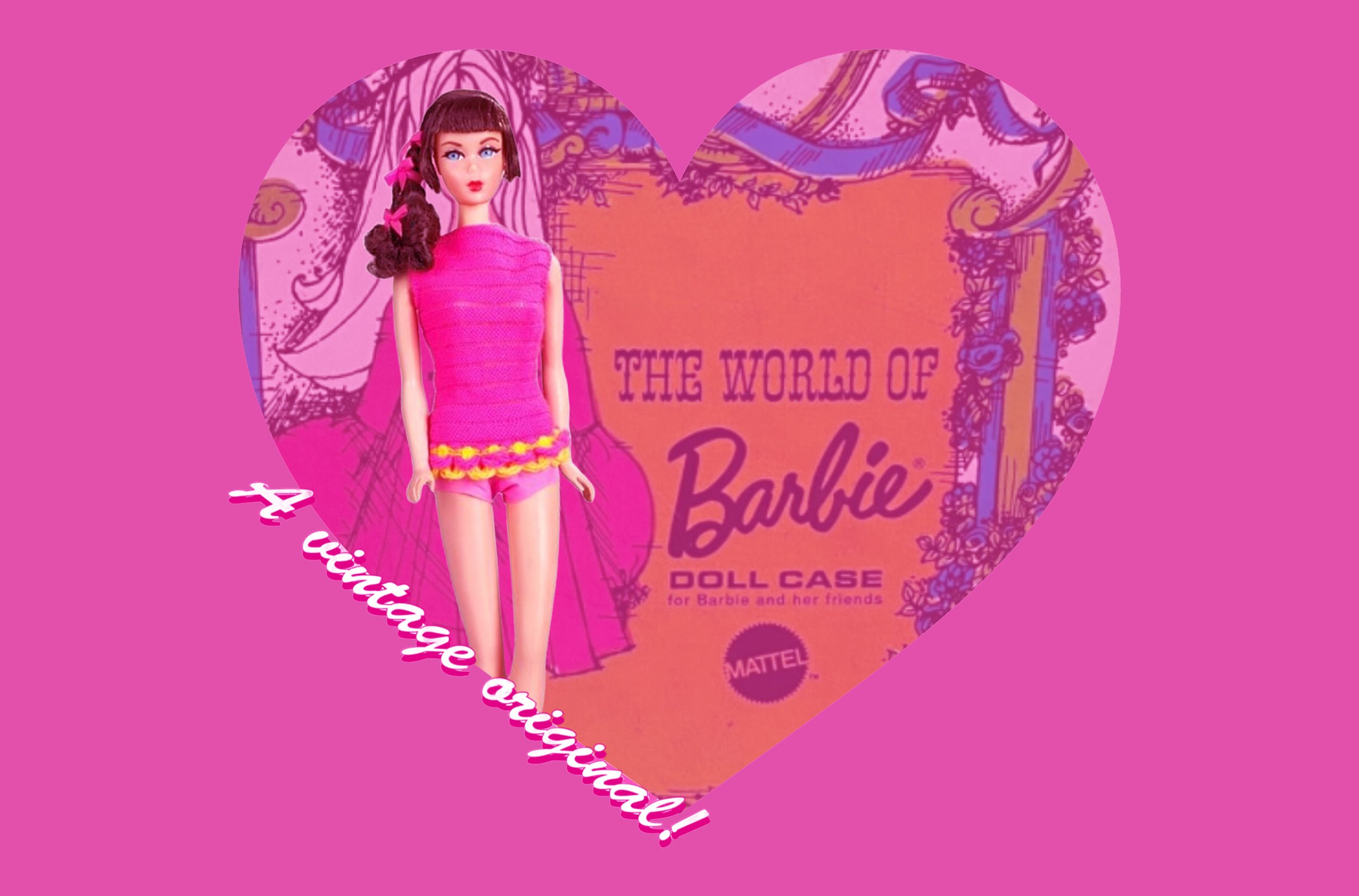
My Barbie resided in her ‘The World of Barbie’ carrying case, wearing her original hot pink shorts and a yellow wool trimmed bright pink sleeveless top. My pocket money paid for a shocking pink and white lace, bell-bottomed jumpsuit (note to collectors - #1823 jump into lace). I pored over Barbie brochures and fantasised about her dreamy pink nightgown (#1857), pink extravaganza (#1844), and layered pink net romantic ruffles (#1871). Yet her wedding “wonder” dress, a dotted organza veil over satin petticoat, with collar and bows (#1849), was traditionally white.

Mine was the first ever Talking Barbie. Her soundbites, indelibly audible to me, formed my future. 

“How shall I wear my hair?”

“I have a date tonight!”

“Let’s go shopping!”

“What’s showing at the cinema?”

“Which new dress shall I wear?”

“Let’s play some records!”

Had I known the voice belonged to Janie Wellborne from Kent, would I have been so in thrall?

Barbie, the preternaturally beautiful movie transported me back to that time of childhood innocence, and sense of wonder. Her struggles as she escaped from the safety and security of her box into the confusion of adolescence. And the real world, where black became a symbol of toxic masculinity and subservient women. Real life can be scary, dangerous and traumatic. Sadly, my Barbie eventually got injured. In fact one of her legs is strapped to the other with a hairband. It happened when she tried to ride Sindy’s horse.

Record box office figures prove that Barbie is far from dead. She continues to be reinvented. Mattel have even launched a Barbie doll whose body is made from 90% recycled ocean-bound plastic, and the company aims to use 100% recycled, recyclable, or bio plastic for all of its Barbie products and packaging by 2030. The future of pink is green, as they say.

So, Dear Barbie, please don’t wish for a gynaecologist. Stick to your world free of period and labour pains. A world where men are stylish accessories, to joke and play with. And you can be anything you want. You will always live on in our hearts and minds: your legacy an immortal testament to the power of pink.

In reviews Tags film, fashion, legacy, colour, material culture
← Sargent and Fashion: The artist as creative director and stylistLife as Legacy: how would you like to be remembered? →

Latest Posts

Featured
Past Lives, Future Poses: Marie Antoinette and the Blitz Kids
articles
Past Lives, Future Poses: Marie Antoinette and the Blitz Kids
articles

Marie Antoinette and the Blitz Kids never met, yet they shared a love of dressing up. Both made excess their armour, spectacle their shield, and performance their survival strategy.

Read more →
articles
Sargent and Fashion: The artist as creative director and stylist
reviews
Sargent and Fashion: The artist as creative director and stylist
reviews

Notwithstanding the skilled brush strokes of a master artist, some of the techniques of John Singer Sargent’s trade are similar to those employed by contemporary fashion stylists and online content creators.

Read more →
reviews
You've Come a Long Way, Barbie: The everlasting power of pink
reviews
You've Come a Long Way, Barbie: The everlasting power of pink
reviews

Barbie’s colourful cinematic world and powerfully pink wardrobe rekindle memories of my playdates with the original 1968 talking version of the doll.

Read more →
reviews
Life as Legacy: how would you like to be remembered?
articles
Life as Legacy: how would you like to be remembered?
articles

Reflecting on our mortality can put life into perspective and help give meaning to our existence. A thought piece on death and remembrance. How rich is your legacy?

Read more →
articles
Dress Codes, Gender and the Power of Subversion
research
Dress Codes, Gender and the Power of Subversion
research

People who transgress fashion norms are often viewed with suspicion, distrust, or even disgust. Yet going against the grain can also empower, by getting us and our causes noticed…

Read more →
research
19th Century Mourning dress: clothing customs to commemorate the dead
research
19th Century Mourning dress: clothing customs to commemorate the dead
research

Formal rituals of bereavement became a yardstick of behaviour. The study of mourning dress provides an insight into the social position of women, in particular. Women bore the heaviest burden of the mourning ritual, becoming social outcasts for their first year of widowhood.

Read more →
research
Craft, Colour and Phenomenal Style: Zandra Rhodes Retrospective at Fashion and Textile Museum
reviews
Craft, Colour and Phenomenal Style: Zandra Rhodes Retrospective at Fashion and Textile Museum
reviews

By way of dreamlike inspiration, intoxicating colour combinations and towering displays of spectacular gowns appear on this journey through the realms of a legendary creative force.

Read more →
reviews
Playing Grown-Ups: Mary Quant Comes of Age
reviews
Playing Grown-Ups: Mary Quant Comes of Age
reviews

The collision of girly innocence with the overt sexuality of a newly liberated age that radiated through Quant’s products and their promotion was simultaneously borne out in my generation’s experience of growing up.

Read more →
reviews
War Against Fear: FOMO, FOLO, FODO and 21st Century Phobias
trends
War Against Fear: FOMO, FOLO, FODO and 21st Century Phobias
trends

We live in precarious times, with the ever-present threat of revolution, a worldwide pandemic, or nuclear war. Every human being has an innate fear of death, yet today we also seem to struggle with a fear of life itself.

Read more →
trends
Marvel, Magic and Mastery: Christian Dior at the V&A
reviews
Marvel, Magic and Mastery: Christian Dior at the V&A
reviews

There is a sense of timeless elegance - even Galliano’s boldly coloured kneepads and Chiuri’s sci-fi-style ‘mystic masks’ sit happily alongside Bohan’s delicate costume jewellery and the more classic millinery of early collections.

Read more →
reviews