When did dressing a larger body become an act of defiance - and when did concern about obesity become indistinguishable from contempt? Where does honest aesthetic judgement end and body prejudice begin?
To the man on the plane occupying most of the aisle seat and a substantial portion of the empty middle seat in BA Club Class: I did not wish to encounter, at luggage reclaim, the great pale escarpment of flesh that had escaped over the top of your trousers. I did not object to your body in principle - I objected to being involuntarily introduced to so much of it.
And to the woman in the satin slip skirt whose stomach rose above its elasticated waist: was the protruding belly button part of the look? As for pregnancy bumps emerging beneath crop tops, I understand that pregnancy is natural, miraculous and no longer something women are expected to conceal beneath a floral smock. But must every physical reality be made visible merely because it exists?
Am I being unreasonable? Possibly… More uncomfortably, might I be revealing something about myself?
I was on my way back from a wellness retreat where we drank vegetable juice, ate very little and spent a week discussing exercise regimes, digestive issues and vital statistics. None of the guests appeared to be living with obesity. Most were trying to lose the same persistent half-stone that had followed them through middle age.
It is easy, from inside such a rarefied environment, to imagine that weight is simply a matter of discipline. We had paid handsomely to be deprived of bread. Hunger was reframed as purification, restriction as self-command, and the shrinking body as evidence that we had used our time productively.
But thinness is not always proof of virtue, just as fatness is not proof of failure. This distinction becomes particularly difficult in fashion because clothes do not merely cover our bodies - they rank, frame, reveal, discipline and define them.
Is this about fat or fit?
Perhaps my complaint about the man on the plane was not really about his obesity? It was about trousers that did not fit and flesh entering a shared space without invitation.
Poorly fitting clothes can make almost any body appear neglected. A slim man in a shirt straining at the buttons looks badly dressed. A narrow woman in trousers that expose her underwear looks badly dressed. Yet when the wearer is fat, the sartorial offence is quickly converted into a moral one. The garment does not fit because, we assume, the person has failed to control themself.
The larger body is rarely permitted to be merely badly dressed. It must be greedy, lazy, undisciplined or defiantly “body positive.” Its appearance is interpreted as character evidence.
Sociologist Erving Goffman described stigma as a process through which a characteristic becomes socially discrediting, reducing a whole person to a supposedly spoiled identity. Fatness operates particularly powerfully in this way because it is visible, culturally loaded and commonly treated as self-inflicted (Goffman, 1963).
Fashion intensifies the judgement. As Joanne Entwistle argues in The Fashioned Body, dress is a “situated bodily practice”: it mediates between the private body and the social world. We are not assessed as bodies alone, nor as clothes alone, but as dressed bodies moving through particular environments (Entwistle, 2000).
This may explain why a large person in a beautifully cut coat can appear commanding, while the same body in saggy leggings may provoke disgust. The body has not changed, but its social presentation has.
Fat as moral failure
Western attitudes towards large bodies have never been historically fixed. Corpulence has variously suggested prosperity, fertility, political power, comic excess and physical abnormality.
In societies where food was scarce, substantial flesh could signify abundance. Thorstein Veblen associated conspicuous consumption with the public display of wealth and exemption from labour. A body apparently untouched by physical work and amply supplied with food could therefore communicate status rather than failure (Veblen, 1899).
This did not mean that fat people were free from ridicule. The excessively large body was also exhibited as spectacle.
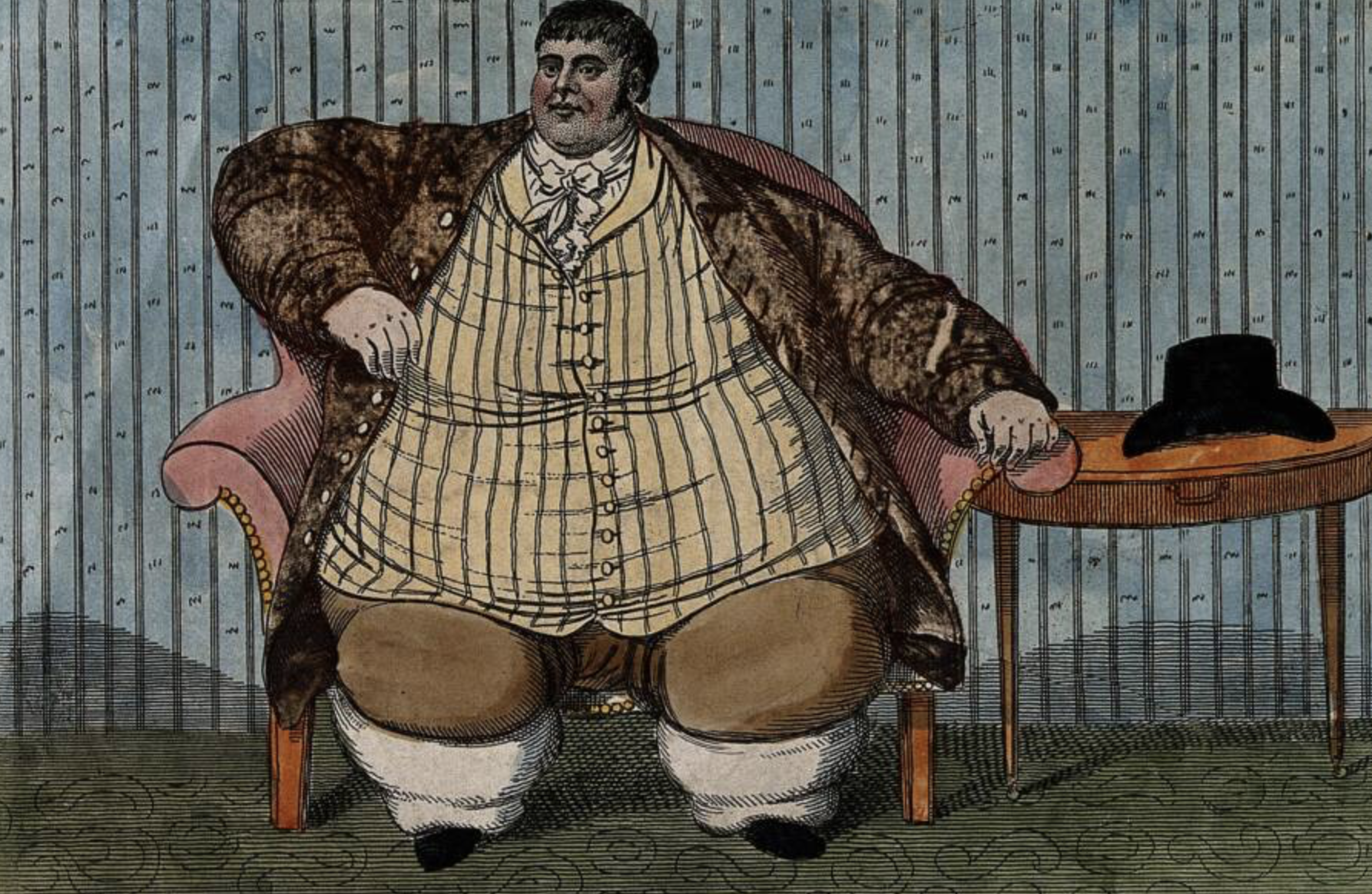
Daniel Lambert, born in Leicester in 1770, became one of the most famous fat men in British history. By the end of his life, he reportedly weighed approximately 52 stone 11 pounds (739 pounds). Unable to continue working, he exhibited himself to paying visitors and became a national curiosity. Yet surviving portraits do not present him as sartorially abandoned. He appears in a carefully fitted coat, waistcoat, breeches and cravat: composed, dignified and conspicuously dressed. His clothes and other possessions were subsequently preserved as objects of historical interest.
Lambert’s clothing matters. It separates physical magnitude from social disorder. His body may have been regarded as extraordinary, but it was not allowed to appear careless. Lambert’s clothes required unusually large quantities of fabric, but his portraits remind us that size and formality are not incompatible. The body can be extraordinary; the tailoring can still be exact.
During the nineteenth and twentieth centuries, fatness became increasingly entangled with medical measurement, racialised aesthetics, class prejudice and ideas of self-control. Sabrina Strings argues in Fearing the Black Body that the Western preference for thinness cannot be understood solely as a modern response to medical evidence. It also developed through racial and religious ideologies that associated bodily restraint with white European civility and excessive appetite with supposedly inferior others (Strings, 2019).
The modern fat body is therefore judged through several overlapping systems. Medicine may classify it as risky; fashion may classify it as difficult; popular morality may classify it as undisciplined, whilst social media may alternately celebrate and ridicule it. The body is simultaneously diagnosis, market, political identity and spectacle.
Dressing large bodies
For much of modern fashion history, larger women were not invited to participate fully in fashion - they were managed by it.
“Stoutwear,” as it was often called in the early twentieth century, was designed around concealment and correction. Garments were expected to minimise the stomach, disguise the hips, lengthen the figure and produce the optical suggestion of reduced volume. Dark colours, vertical seams, firm fabrics and discreet prints formed a visual language of apology.
The message was clear: the large woman could be elegant, provided she attempted to not look large.
Later, the term “plus size” (or even “outsize”) created a distinct commercial category, although one that remained separated from fashion’s imagined norm. The larger customer was frequently offered diluted versions of mainstream trends: longer sleeves, higher necklines, safer colours and fewer decorative details. She could buy clothes, but not always the fantasy attached to them.
Research into plus size consumption repeatedly identifies restricted choice, inconsistent sizing, poor retail experiences and the psychological consequences of shopping in a market that treats larger customers as an afterthought. Clothing sizes are not neutral measurements; they help establish which bodies are understood as normal and which are positioned as deviations requiring specialist provision.
The supposedly inclusive expansion of fast fashion has changed this. Stretch fabrics, elasticated waists, oversized T-shirts, leggings and inexpensive trend-led clothing have made it possible for more people to dress fashionably at more sizes.
Has this facilitated obesity?
It would be a substantial leap to say that leggings have made Britain fat. Clothing responds to bodies more readily than it creates them. Yet clothes can alter our awareness of bodily change. A rigid waistband reports every additional inch; an elasticated one accommodates it silently. Tailoring imposes limits, whereas stretch is more forgiving.
The disappearance of discomfort may remove one early indication of weight gain - but it also allows people to move, work and participate in society without enduring garments that are instruments of punishment.
Vital statistics
The 2024 Health Survey for England found that 30 per cent of adults were living with obesity, while 66 per cent were either overweight or living with obesity. Obesity was more prevalent among older adults, affecting approximately 35 to 36 per cent of those aged between 55 and 74.
This remains a major public-health concern. Obesity is associated with increased risks of type 2 diabetes, cardiovascular disease, joint problems and certain cancers. It is also more common in deprived communities. Food affordability, working patterns, neighbourhood environments, genetics, medication, disability, sleep, mental health and access to preventive healthcare can all influence weight. Personal behaviour matters, but it does not occur in a social vacuum.
More affluent people can purchase environments in which temptation is temporarily removed, meals are controlled, exercise is scheduled and ordinary responsibilities are suspended. Does that mean the less well off require stronger will power to lose excess weight?
The injection objection
What about GLP-1 medicines? Surely semaglutide, tirzepatide and their successors have made weight loss straightforward?
They have undoubtedly changed the conversation. They can produce substantial weight loss for some patients and may improve important health outcomes. It is worth noting that these are prescription medicines, not universal aesthetic correctives. NICE recommends them for defined groups of adults and in conjunction with dietary and physical-activity interventions. Eligibility, clinical suitability, cost, side effects, supply and long-term adherence all matter. NICE’s guidance treats them as medical interventions for managing overweight and obesity, not as compulsory treatments for anyone whose appearance displeases a stranger.
A person may wish to lose weight and be unable to do so. Another may actively lose weight but still remain large. A third may have decided that repeated dieting has caused more damage than stability would. We cannot diagnose any of these circumstances at luggage reclaim.
Body positivity - or compulsory admiration?
The original body positivity movement emerged from fat activism and demanded something worthy beneath its confidence boosting slogans: that larger people should not be denied dignity, healthcare, employment, fashionable clothing or public participation because of their size.
Its commercial version was less righteous. Brands discovered that diversity could sell moisturiser and underwear. “Love every inch” appeared on advertisements produced by industries still organised around idealised bodies. Acceptance became an aesthetic campaign.
There is nevertheless a legitimate question lurking beneath the backlash: does equal dignity require us to describe every body as beautiful? Nobody is obliged to find every body attractive. We do not demand universal admiration of every face, haircut, outfit or pair of shoes. The ethical requirement is not desire but civility.
Body positivity becomes intellectually weak when it treats all discussion of health as hatred, or insists that physical appearance must be exempt from aesthetic judgement. But criticism becomes cruelty when it converts private taste into a public verdict on another person’s worth.
We should be able to say that obesity carries health risks without describing fat people as gelatinous, disgusting or morally defective. We should also be able to say that a garment fits badly without pretending that every exposure of flesh is inherently empowering.
The fetishisation of fat
Fatness is not only stigmatised. It is also fetishised.
The fetishisation can be sexual, commercial or spectacular. In each case, the larger person risks being reduced to the body part or appetite that fascinates the observer.
The “feederism” subculture eroticises weight gain, feeding and bodily expansion. Online content may focus on stomachs, eating, immobility and the deliberate crossing of physical boundaries. The fat body becomes desirable precisely because it is excessive.
Popular culture often operates similarly without acknowledging the erotic dimension. It lingers over food entering mouths, clothing splitting, chairs creaking and bodies struggling through doorways. The viewer is invited to feel horror, delight and fascination simultaneously.
Simon Rumley’s novel The Wobble Club pushes this appetite for excess into grotesque territory. Its central couple, Brolly and Gill, weigh more than 400 pounds each and organise much of their lives around eating. The novel’s graphic descriptions of consumption make food almost pornographic: repeated, excessive and grossly physical. Brolly’s attempt to change after the obesity-related death of a friend collides with Gill’s determination to continue their shared rituals.
The title itself converts bodies into movement and movement into entertainment. Yet the grotesque can serve two opposing functions. It can expose the corporeal consequences of extreme consumption, or it can allow the reader to enjoy disgust while imagining themself safely different. The obese person becomes a cautionary spectacle: Look how far they have gone. Look how unlike them I am.
Do we need fat role models?
The expression “obese role model” is peculiar. We rarely describe a thin actress as a “low-BMI role model,” even though her body may be equally central to her public image. What larger people need are not necessarily role models for obesity, but examples of larger bodies being understood for their complexity.
Ashley Graham has often worn conventionally glamorous, body-conscious clothes that refuse the old requirement that larger women conceal their waists and upper arms. Paloma Elsesser has appeared in luxury fashion and editorial imagery without being presented merely as an instructive symbol of confidence. Lizzo has used corsetry, cut-outs, performance wear and deliberate exposure to turn bodily visibility into theatre. Nicola Coughlan has repeatedly demonstrated that fashion on a larger body need not be reduced to camouflage.
These women do not all dress alike, nor do they deliver a single message. Perhaps representation becomes meaningful when the larger body no longer has to stand only for largeness? Still, fashion’s embrace is conditional. A plus size model is expected to possess exceptional beauty, confidence and proportionality. The approved larger body usually has a defined waist, smooth skin, symmetrical features and an hourglass silhouette. Fat is accepted most readily when it arranges itself attractively.
The ordinary fat body remains a more difficult proposition.
Is exposure the real offence?
Would I have reacted differently to the stomach above the satin skirt had it belonged to a size-eight woman? Almost certainly.
Fashion has normalised the exposure of thin bodies. A narrow midriff is read as a styling detail. A larger stomach is read as a statement, even when the wearer intended no statement at all. This is where aesthetic judgement becomes unreliable. We may believe we are objecting to the garment when we are objecting to the body permitted to wear it.
The pregnant crop top complicates matters further. Pregnancy was historically concealed, then discreetly accommodated, and is now frequently displayed. The exposed bump may represent pride, comfort or resistance to the idea that the maternal body must retreat from sexuality and fashion.
I may not like the look. But dislike is not the same thing as impropriety. Perhaps the more useful question is not, “Should that body be visible?” but, “Why does its visibility disturb me?”
The final fitting
I began with a man at an airport whose exposed flesh offended me. Perhaps he needed larger trousers and/or a better designed aircraft seat? What I cannot know is whether he was lazy, ill, losing weight, gaining weight, indifferent, ashamed, or simply hot and uncomfortable after a long flight. I transformed a visible strip of skin into a biography because fatness encourages precisely that presumption.
We should be concerned about rising levels of obesity. We should ask difficult questions about diet, public health, poverty, food production, medical treatment and the environments in which people live. Fashion should not pretend that every physical condition is healthy merely because every person deserves respect. But neither should concern for health become a respectable costume for disgust. The larger body does not have to be fetishised, celebrated or found beautiful. It does have to be clothed, accommodated and allowed to exist without being treated as a public confession of moral failure.
Oh, and whatever your size, your trousers should cover your bottom.
References
Entwistle, J. (2000) The Fashioned Body: Fashion, Dress and Modern Social Theory. Cambridge: Polity Press.
Goffman, E. (1963) Stigma: Notes on the Management of Spoiled Identity. Englewood Cliffs, NJ: Prentice-Hall.
LeBesco, K. (2004) Revolting Bodies? The Struggle to Redefine Fat Identity. Amherst: University of Massachusetts Press.
Puhl, R.M. and Heuer, C.A. (2009) ‘The stigma of obesity: a review and update’, Obesity, 17(5), pp. 941–964.
Strings, S. (2019) Fearing the Black Body: The Racial Origins of Fat Phobia. New York: New York University Press.
Veblen, T. (1899) The Theory of the Leisure Class. New York: Macmillan.
Wann, M. (1998) Fat! So? Because You Don’t Have to Apologize for Your Size. Clarkson Potter/Ten Speed Press.