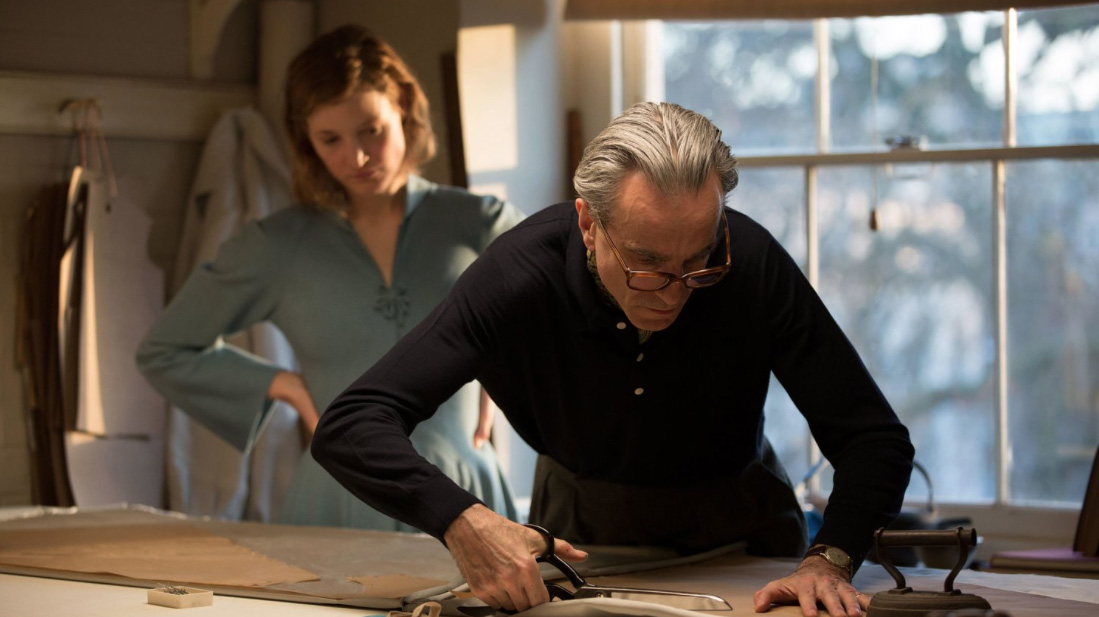
I wish I had taken a psychoanalyst with me to see Paul Thomas Anderson’s film Phantom Thread. Instead, I persuaded my husband to go along - the least likely person to enjoy a film about couture fashion, let alone one with a running time of over two hours. I would have appreciated some professional help to analyze the sadomasochistic relationships between the main characters, for this is essentially a film about relationships: Couturier Reynolds Woodcock’s relationships with his sister and right-hand woman, Cyril; with newfound love, Alma; with his fashion house - and, ultimately, via an Oedipal fascination for his late mother, with himself.
As soon as the film title with its befitting typeface appears, we are transported into the self-obsessed and ritualistic world of the 1950s House of Woodcock. The master of the house, convincingly played by Daniel Day-Lewis, is as obsessive as any leading fashion designer today. Yet, Lesley Manville’s imperious Cyril - her man’s name meaning ‘lordly,’ or ‘masterful’ - rules the roost, with a firm hand and withering put-downs. Plus, Woodcock is dependent for his existence upon the clients for whom he demonstrates an almost Gallianoesque disdain.
It soon transpires that Woodcock, a confirmed bachelor who is comfortable measuring women’s bodies, is not so at ease when dealing with the simple matters of everyday life. There is also a degree of ambiguity surrounding both his sexuality and his relationship status. He is as attached to textiles and garments as he is set in his ways, but the immutable fabric of his life is turned upside down by the unexpected and late arrival of love.
The film moves at the pace by which handmade garments are created. The precision and fastidiousness of Woodcock’s craft must be experienced in order to understand the level of dedication and self-discipline required of his industry and the degree of self-control required of his mind and person. In this era of slow fashion, couture clothing was quotidian for the upper and upper middle classes. The world at large does not intrude upon this perfectly ordered microcosm of fashion, style and predetermined taste.
Snobbery and sexism were an accepted part of life. Cyril, affectedly pronounced in the French way, as Cyrille, is affectionately known as “Old So and So”. Designer Mark Bridges’ stiff, corseted costumes bear the hallmarks of an age of repression: although uncomfortable to wear and difficult to walk in, the colours, textures, finishes, details and coded messages sewn into the seams manifest the genuine love and attention expended in creating the garments. The maturely rotund and bespectacled artisans of the atelier are expertly cast against elegantly aloof models, whose only job is to serve as walking embodiments of the brand, which must remain untainted at all times.
Food appears often, and not always in the most conventional way. The protagonists’ hunger for each other is mirrored in their appetites and eating habits. It is no coincidence that the name Alma means ‘fostering’, or ‘nourishing’ - and actress Vicky Krieps excels at showing how an unexpected ingredient can add frisson to a life made weary by everyday routine. Despite Woodcock’s world revolving around social standards and personal etiquette, Alma puts her wrists on the table, holds her knife the wrong way, grates her teeth along her cutlery, clatters her bread knife on her plate and makes too much noise when she butters her toast. Through these deviances, she provides the soupçon of disorder required to elicit a response, the Meisterstuck borne from a distinctly Germanic enthrallment with the inexact science of mushroom spotting. Disorder turns out to be a good thing: “A house that doesn’t change is a dead house”. Just look at the 1950s British couturiers who were left behind by the rising stars of Dior’s ‘new look’ and Chanel’s comeback: where do Norman Hartnell, Hardy Amies and Charles James feature in the world of womenswear today?
The ‘phantom thread’ in the title, although derived from the concept of seamstresses perpetually feeling a needle between their fingers, is also present throughout in the form of Woodcock’s late mother. There are elements of superstition, but to me, the underlying currents and tensions owe more to Hitchcock than gothic horror. And the main thread seems to be Freudian: dreams reveal the inner thoughts of a man’s heart. A relationship can work, just so long as one is prepared to occasionally hold a sick bucket, ignore loud chewing, let go of past attachments, give a partner space - and reserve judgement on their choice of films.
This review first appeared at www.margueritedeponty.com